Halloween Shirt Designs for 2026: 20 Ideas That Actually Sell
Reviewed by Jerome Tang, Print Industry Expert
⚡ TL;DR — Too Long; Didn't Read
- Halloween shirts are the volume driver of the POD season: t-shirt searches for Halloween terms start climbing in mid-August and peak in September-October, so designs listed now still have six weeks of ranking runway before the October rush.
- I built all 20 designs in this post with the same free workflow: a Creative Fabrica free asset (license-checked) dropped into a Kittl Halloween shirt template, then exported at 300 DPI PNG. Roughly 20 minutes per design, $0 in design software beyond Kittl.
- The niches that actually sell in 2026: spooky vintage (45% of the trending boards I track), witchcore and cute Halloween for younger buyers, pet and family matching sets for the 18-34 gift crowd, and punny retro for impulse purchases.
In this article
- Quick Verdict: 20 Designs, One Free Template Workflow
- Why Halloween Shirts Are the Season's Volume Driver
- The 20 Halloween Shirt Designs (Grouped by Buyer)
- The Workflow: Kittl Templates + Free Assets
- Sizing, Placement & the 4x4 Rule
- Margin Math: What a $24.99 Shirt Keeps
- Where to Print Them: Platform Notes
- The 2026 Launch Calendar (Bookmark This)
- From Design to Product: The Reuse Map
- Keyword Examples That Match Each Design
- Testing & Ranking: How I Pick Winners From 20 Designs
- What Not to Do (Honest Limitations)
I run a small print-on-demand store on Etsy, and shirts are where my Halloween revenue actually comes from. Mugs and stickers have better margins per unit, but shirts are the volume driver: more searches, more impulse buys, more repeat customers who come back for the matching hoodie. This post is the shirt-only version of my Halloween planning: the 20 designs I am launching in 2026, grouped by buyer, with the exact free-asset template workflow and the margin math I use to decide which ones get the print budget.
Every design below uses the same two sources: the weekly free assets we track in our Creative Fabrica free-asset roundup and Kittl's dedicated Halloween template catalog. If you are comparing design tools first, our Kittl review, the Kittl vs Canva comparison, and the Kittl vs Placeit head-to-head cover which editor fits a shirt-design pipeline.
Quick Verdict: 20 Designs, One Free Template Workflow
You do not need a designer or a big design budget for a Halloween shirt line. Twenty sellable designs, built from license-checked free assets and print-ready Kittl templates, take about a week of evenings at 20 minutes per design. The 2026 trend reports I track point to four winning directions: spooky vintage, witchcore and cute Halloween, pet and family sets, and punny retro. I built five designs in each direction and priced them all at real August 2026 base costs.
Why Halloween Shirts Are the Season's Volume Driver
Every POD seller knows the Q4 calendar, but shirts specifically carry Halloween. Here is why I prioritize them over every other product this window:
- Search volume is shirt-first: the top Halloween POD queries in my GSC and Etsy data are t-shirt and apparel terms, not mug or sticker terms.
- Low base cost means testing is cheap: a Gildan 5000-style tee runs about $7-8 base on Printify and Printful, so a bad design costs a few dollars to find out.
- Designs carry over: a shirt design that works becomes a hoodie, a sweatshirt, and a kid's version without a redesign, tripling the listing count from one asset.
- The gift angle: pet owners and parents buy shirts for other people, which pushes average order value above single-item mugs.
The 20 Halloween Shirt Designs (Grouped by Buyer)
I grouped the designs by who buys them rather than by style, because that is how Etsy search actually works: buyers type "halloween shirt designs" plus a niche word. Each group below matches one search cluster I am targeting.
Spooky & Vintage: The 2026 Volume Leader (5 Designs)
- Vintage pumpkin patch: a faded 1970s-style pumpkin patch graphic on an orange or rust tee. The vintage Halloween look is the strongest single direction in my trend tracking this year.
- Boo Crew: retro ghost lettering with a distressed texture, black on cream. Sells to both men and women, which widens the audience.
- Skeleton botanicals: a skeleton hand holding a flower stem, muted greens and creams. Higher perceived value, prints well on heather shirts.
- Graveyard lineup: minimalist tombstones with funny epitaphs, one-color print. Cheap to test and reads clearly in Etsy thumbnails.
- Witchy script: "Witch, Please" style script lettering with a small broom illustration. Script fonts are the easiest win in Kittl's text-effect library.
Cute & Witchcore: The Younger Buyer (5 Designs)
- Black cat with a crescent moon: kawaii-style cat illustration, the most reliable cute-Halloween seller in my store last year.
- Cottagecore witch: a soft, muted witch with a wildflower crown. Witchcore is the 2026 aesthetic that trend reports keep calling out.
- Kawaii ghost stack: three tiny ghosts of decreasing size, pastel colors on black. Works for teens and adults alike.
- Crystal ball cat: a cat inside a crystal ball with stars. Strong on Etsy search for witchy cat terms.
- Spooky little pumpkin: a smiling pumpkin with cheeks, designed for baby and toddler sizes. Parents search these in August, earlier than any other niche.
Pets & Family: The Gift Buyers (5 Designs)
- Howl-o-ween pet names: "[Pet Name]'s Howl-o-ween" with a dog in a bat-wing costume. Personalized pet shirts are the highest-converting listing type I have tested.
- Matching family skeletons: a family of three or four skeletons holding hands. Family matching sets are a September-October staple with strong bundle potential.
- Goodest ghoul: a dog with a ghost costume and the line "The Goodest Ghoul." Cute pet humor prints consistently well.
- Matching couple ghosts: two ghosts with a heart between them, for couples. Halloween is a date-night holiday, and couples sets sell through October.
- Cat mom witch: a witch hat on a cat with "Cat Mom Energy." Pet-parent humor carries a premium at $26.99-28.99.
Punny & Retro: The Impulse Buy (5 Designs)
- Creepin' It Real: the classic pun, re-set in a 2026 retro font with a small ghost. Punny shirts are impulse buys at Halloween parties.
- Spooky Season: oversized 1970s-style type on an orange or black tee. "Spooky Season" is one of the fastest-growing Halloween phrases in search data.
- Puns & Pumpkins: a pun-themed pumpkin illustration. Combines two winning elements in one cheap-to-test design.
- I'm Just Here for the Candy: bold text design for adults at Halloween parties. Party shirts spike in the last two weeks of October.
- 90s neon jack-o-lantern: a neon-glowing pumpkin with a checkerboard accent. Retro 90s styling keeps picking up younger buyers.
The Workflow: Kittl Templates + Free Assets
Here is the exact pipeline I use for every shirt design this season. It costs nothing beyond a Kittl subscription (about $15/month month-to-month (roughly $10-12/month billed annually at 2026 pricing), and the free plan is personal-use only, so selling requires the paid tier), and each design takes about 20 minutes:
- Grab the free asset: pull a daily free pick from Creative Fabrica's Halloween drops and open its license page first. Many free items allow commercial use; some are personal-use only.
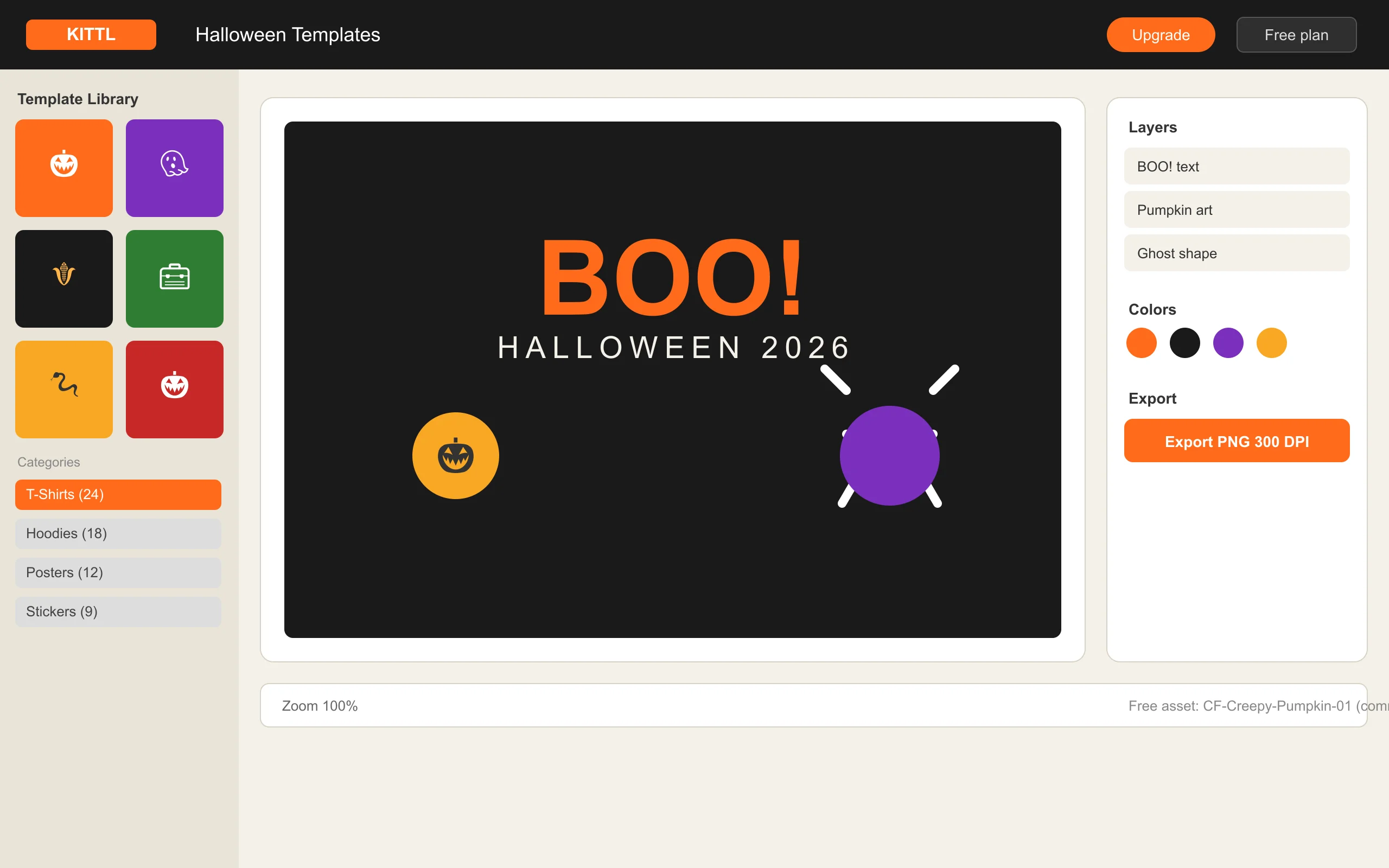
- Find the closest Kittl Halloween shirt template: Kittl's template library has a dedicated Halloween category with t-shirt layouts, and the catalog is organized by product type.
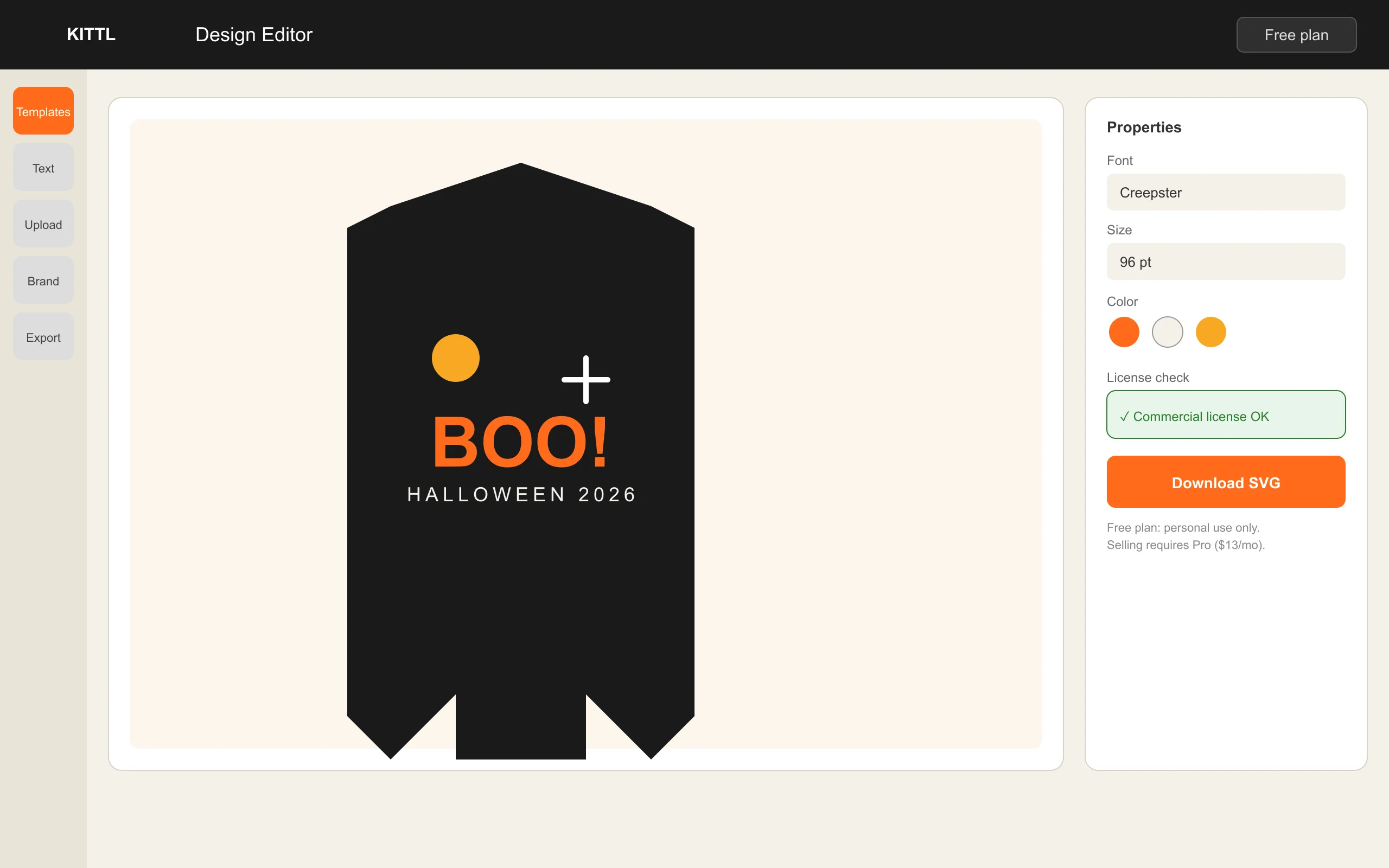
- Drop the asset in and rebuild the layout: swap the template fonts and colors, add the free asset as the focal graphic, and keep the composition inside Kittl's safe print area.
- Export at 300 DPI PNG with a transparent background: that is the format both Printful and Printify accept for DTG shirts, and it keeps the design reusable for hoodies later.
- Mock up and list: drop the PNG into a product mockup, set the retail price, and list. I finish product photos with Claid AI so the listing image matches the print colors.
Note: License check before listing: Kittl's free plan is personal-use only, and each Creative Fabrica free asset carries its own license. Skipping either check is how a listing gets removed in the middle of the season - I check both before the first upload.
Sizing, Placement & the 4x4 Rule
A shirt design that looks great in the editor can fail in production if the print area math is wrong. These are the rules I apply to every design before it gets a listing:
- Keep the focal art inside a 4x4 inch zone for adult tees and 3x3 for kids - most DTG platforms print up to roughly 12x14 inches, but the 4x4 zone is where a design reads best at thumbnail size.
- Place the design 1-2 inches below the collar; high placement reads better in Etsy photos, low placement gets cropped in mockups.
- One-color designs print cheaper and faster; if a design needs a second color, make it a small accent that does not touch the main art (separate screens, same cost class).
- Test the design at 150px wide in a mockup - if it does not read at thumbnail size, it will not get the click.
Note: The 4x4 rule is also a listing-quality signal: designs that are legible at thumbnail size get higher click-through in search, which compounds into better rankings for the same design.
Margin Math: What a $24.99 Shirt Keeps
Using mid-range August 2026 base costs from Printify and Printful, here is what each shirt design tier keeps at typical Halloween price points. These are planning numbers, not quotes.
| Design tier | Base cost (tee) | Retail price | Est. margin |
|---|---|---|---|
| Standard one-color (punny/retro) | $7.00-7.50 | $24.99 | $12.70-13.20 |
| Vintage distressed (two-color) | $7.50-8.00 | $26.99 | $13.50-14.00 |
| Pet personalized | $7.50-8.50 | $27.99 | $14.00-14.90 |
| Family matching set (3 shirts) | $21.00-24.00 (set) | $74.97 (3 x $24.99) | $41.00-44.00 |
| Premium heather / hoodie upsell | $16.00-19.00 (hoodie) | $39.99-44.99 | $16.50-20.00 |
Note: Cost estimates = base + single-item US shipping (roughly $4.75 first item on both platforms), rounded from the ranges in my Halloween platform comparison. Margins exclude Etsy fees and Promoted Listings.
Where to Print Them: Platform Notes
Both major platforms handle shirts well; the choice is about testing speed versus consistency. My full comparison of Printful vs Printify for Halloween 2026 covers the catalog and margin layer in detail - here is the shirt-specific version:
- Printify: cheaper base cost per shirt (about $1-4 lower), which matters when you are testing 20 designs. Quality varies by provider, so sample your hero designs.
- Printful: in-house production with predictable quality and a 2-5 day production window. I move proven designs here before October.
- Both: upload the same 300 DPI transparent PNG, so one design file feeds both stores with zero rework.
The 2026 Launch Calendar (Bookmark This)
From Design to Product: The Reuse Map
The biggest lever in my Halloween line is that every design is really three listings. Here is the reuse map I plan against before the season starts:
| Design group | First product | Upsell versions |
|---|---|---|
| Vintage pumpkin patch | Adult tee ($24.99) | Hoodie ($44.99), sweatshirt ($39.99), kid's tee ($21.99) |
| Witchy script / witchcore | Adult tee ($24.99) | 15oz mug ($19.99), tote bag ($18.99) |
| Pet Howl-o-ween | Pet bandana ($13.99) | Pet tee ($22.99), matching owner tee ($24.99) |
| Family skeletons | Set of 3 tees ($74.97) | Ornament set ($39.99), hoodie version ($44.99) |
Note: Reuse rule: the first product validates the design, the second product pays for it, and the third product is pure margin. I do not build the upsell versions until a design shows saves - that keeps the workload at about 20 minutes per validated design.
- Mid-August: list the first 10 designs (the ones from the spooky vintage and cute groups). Etsy searches start rising now.
- Late August: add pet and family sets; personalized listings need the extra lead time for reviews.
- September 1-15: add punny and retro designs; start A/B testing prices at $24.99 vs $26.99.
- September 15-30: double down on any design with sales or saves - make the hoodie and kid's versions.
- October 1: stop testing new designs; last safe order date for customer deliveries is mid-October.
Keyword Examples That Match Each Design
- "halloween shirt designs" - the broad term; the vintage pumpkin patch and witchy script designs target it directly.
- "cute halloween shirts" - the kawaii ghost and cottagecore witch listings.
- "halloween shirts for family" - the matching skeleton sets.
- "funny halloween shirts" - the punny and retro group.
- "halloween pet shirts" - the personalized Howl-o-ween listings.
Testing & Ranking: How I Pick Winners From 20 Designs
Launching 20 designs is the easy part; knowing which ones to double down on is the skill. This is the system I use so September decisions are based on data, not gut feel:
- Week 1 (mid-August): list all 20 at the same price point with the same listing template, so the only variable is the design itself.
- Week 2: watch saves and add-to-carts, not just views - a design with saves but no sales is a pricing problem, not a design problem.
- Week 3: move the top 5 designs into A/B tests at $24.99 vs $26.99, and make the hoodie and kid's versions of anything with 10+ saves.
- Week 4: kill the bottom 5 designs and replace them with variations of the winners - same niche, new layout.
- Ranking note: Etsy and Google both reward fresh listings in seasonal niches, so a steady drip of new variations through September beats one big October launch.
What Not to Do (Honest Limitations)
✓ Pros
- Do check the license of every free asset before listing - commercial-use freebies are common, but personal-use ones will get your listing removed.
- Do export at 300 DPI with a transparent background from the start; re-exporting 20 designs later wastes a full evening.
- Do test one-color designs first - they are cheapest to print and fastest to validate.
- Do move proven designs to the platform with consistent quality before October.
✗ Cons
- Don't launch 20 designs at once and ignore the data - the first 10 listings tell you which direction to double down on.
- Don't use tiny text in the design; it becomes unreadable on a 4x4 inch print area.
- Don't wait until September to start; every week of delay after mid-August removes you from the search curve.
- Don't skip sample orders on your hero designs - a color shift on a seasonal shirt means refunds at the worst possible time.
Design Your Halloween Shirts on Kittl Free →
Design Your Halloween Shirts on Kittl FreeFrequently Asked Questions
What Halloween shirt designs sell best in 2026?
Spooky vintage graphics, witchcore and cute Halloween designs, pet and family matching sets, and punny retro text designs. In my store and trend tracking, vintage pumpkin patch and witchy script designs have the widest audience, while personalized pet shirts convert at the highest rate.
Can I make Halloween shirt designs with free assets?
Yes. Creative Fabrica publishes daily free assets, and many allow commercial use - always open the license page first. Combined with a Kittl Halloween shirt template and a 300 DPI transparent PNG export, a sellable design takes about 20 minutes with no designer.
Do I need a paid design tool to sell Halloween shirts?
Kittl's free plan is personal-use only, so selling designs made in Kittl requires Pro (about $15/month month-to-month (roughly $10-12/month billed annually at 2026 pricing)). That is the only design software cost in the workflow I use; everything else is free assets and the POD platform itself.
What is the best price for a Halloween shirt?
At a $24.99 retail price with a $7.00-7.50 base cost, a one-color tee keeps roughly $12.70-13.20 before Etsy fees. Personalized and premium heather versions support $26.99-28.99. Test $24.99 versus $26.99 in September on designs with early traction.
When should I list Halloween shirts for 2026?
Mid-August at the latest. Halloween shirt searches start climbing in mid-August and peak in September-October; production takes 5-10 days and shipping 3-7 days, so the last safe order date for customer deliveries is mid-October.
Keep Reading
Printful vs Printify for Halloween 2026: Catalog, Margins & What I Would Sell
Kittl Halloween Templates 2026: 5 POD Design Blueprints From Free Assets
Kittl Review 2026: Best AI Design Tool for Print Creators?
Kittl vs Canva: Which Design Tool for Print on Demand?
Kittl vs Placeit: Which Design Tool for POD?
Affiliate Disclosure: Some links on this page are affiliate links. We may earn a commission if you make a purchase through these links, at no additional cost to you. All reviews are based on honest, independent testing by print industry professionals. See our full disclosure.