Black Friday Print on Demand 2026: The 10-Week Prep Playbook for POD Sellers
Reviewed by Jerome Tang, Print Industry Expert
⚡ TL;DR — Too Long; Didn't Read
- Black Friday 2026 is Friday, November 27, with Cyber Monday on November 30. Working back ten weeks, your design batch has to be finished by early October - not November.
- Listings need four to six weeks of index time. Designs published in November rarely earn impressions before the sale ends, no matter how deep the discount.
- Your biggest refund risk is not print quality. It is promising delivery dates past each provider's December order cutoff, so publish cutoff dates on every listing by November 20.
In this article
I sell print on demand on Etsy. I have now run two full Q4 seasons through the same store, the same three suppliers and the same pricing logic, which is the only reason this article is worth reading: the variable that changed between year one and year two was the calendar, not the discount. In my first season I started preparing on November 1. The designs were fine. Almost nobody saw them. In the second season I started in mid-September, and the same style of designs sold at full price for roughly six weeks before Black Friday even arrived - which meant the sale itself landed on listings that already had reviews, favourites and search history behind them.
This is the calendar I wish somebody had handed me in year one. It is written for print on demand sellers who fulfil through Printful, Printify, Gelato or a similar network, and it is deliberately boring: no growth hacks, no inventory risk, just the sequence of work that has to happen before the traffic shows up.
Quick Verdict: Ten Weeks, Not Ten Days
Black Friday 2026 falls on Friday, November 27. Cyber Monday follows on November 30. That gives you roughly ten usable weeks from mid-September, and every one of those weeks has a specific job attached to it. Print on demand sellers who start in November are not really competing for sales - they are competing for indexing, and indexing is the one thing a discount cannot buy. A 30% coupon on a listing that Google has never crawled converts close to zero.
Note: The whole playbook in one line: design batch finished by October 10, listings published by October 17, discount decision locked by November 14, holiday cutoff messaging live on every listing by November 20.
The Q4 2026 Calendar for POD Sellers
Everything below hangs off this table. Print it, or copy the dates into whatever you use to plan production, because the failure mode in this business is almost never a bad design - it is a good design that went live three weeks too late.
| Date | What happens | What must already be done |
|---|---|---|
| Sep 12 - Sep 26 | Design batching window | Micro-niches locked, 40+ concepts drafted as cheap thumbnails |
| Sep 27 - Oct 10 | Production and mockup phase | Final artwork at 300 DPI at print size, mockup set generated per product |
| Oct 15 (target) | Listings go live | Titles and meta written for gifting intent, shipping profiles per provider |
| Oct 25 - Nov 7 | Ad and pricing testing | Discount ladder chosen, bundle offers drafted, two ad tests concluded |
| Nov 20 | Black Week begins | Prices locked, cutoff messaging drafted and scheduled |
| Nov 27 | Black Friday | You push traffic - there is no inventory to clear |
| Nov 30 | Cyber Monday | A second, separate peak: different offer from Black Friday |
| Dec 8 - Dec 12 | Printify order cutoff (typical) | Cutoff banner live on every listing |
| Dec 13 - Dec 15 | Printful US standard cutoff (typical) | Cutoff banner live on every listing |
What Q4 Actually Looks Like on the Demand Side
It helps to know how big the wave is before you paddle into it. Adobe Analytics recorded $14.25 billion in US online spending on Cyber Monday 2025 alone - up 7.1% year over year - and the five-day Thanksgiving window from Thanksgiving through Cyber Monday reached $44.2 billion. Across the full 2025 holiday season, Adobe measured a record $257.8 billion in US online spend, up 6.8% year over year, with buy-now-pay-later contributing $20 billion of that. Note what those numbers mean for a POD seller specifically: this is spending on physical goods shipped to a door, which is exactly what you produce.
The supply side is growing just as quickly. Grand View Research values the global print on demand market at $10.8 billion for 2025 and projects $13.1 billion for 2026, growing at roughly 23.6% CAGR through 2033. Printful states on its own site that it has delivered 143.4 million items since 2013. So the honest reading is: more buyers than ever, and more sellers than ever. In a market expanding that fast, being early is the cheapest edge available to a one-person store, because it costs nothing except patience.
The 10-Week Playbook, Phase by Phase
Weeks 1-2 (Sep 12-26): Niche Selection and Design Batching
This phase is unglamorous and it decides your Q4. The rule I follow is breadth first, polish later: three micro-niches and 40 or more rough concepts, rather than five beautifully finished pieces for one audience. In year one I did the opposite - I spent three weeks perfecting a handful of designs for a single hobby niche, discovered the niche was too narrow for gifting traffic, and had nothing left to pivot with.
- Pick three micro-niches maximum. Mine were one hobby niche, one profession niche and one seasonal gifting niche - they behave completely differently in October, and you want that spread.
- Draft 40+ concepts as cheap thumbnails: text only, no mockups, no cleanup. Most will never leave this stage and that is the point.
- Do asset research in one sitting. Seasonal graphics and font bundles are cheapest and most plentiful in September; by mid-November the good ones have been picked over and the search results are full of recycled designs.
- Kill anything you cannot prove the licence for. A takedown in December costs you the listing, the reviews and the ranking you spent ten weeks building.
Weeks 3-4 (Sep 27-Oct 10): Production and Mockups
This is the phase where AI tools genuinely pay for themselves, and it is worth being specific about why. Print on demand margins are decided before a single sale: the difference between a seller who publishes 20 products and one who publishes 80 is rarely creative talent, it is the number of times they had to open Photoshop. Anything that turns a 20-minute manual chore into a 40-second one changes your Q4 throughput by a multiple, not a percentage.
- Clean and upscale the shortlisted artwork to 300 DPI at the actual print size of each product - not the size of the source file.
- Generate a full mockup set per design: one hero, one on-model or lifestyle, one close detail. Marketplaces reward listing completeness, and buyers scroll past single-image listings.
- Name every file by SKU and product code before upload. Uploading 200 unnamed PNGs is how October turns into November.
- Re-check bleed and safe margins on every product type once, at the batch level. DTG, sublimation and cut-and-sew have different safe areas and a seasonal deadline is a terrible time to discover that.
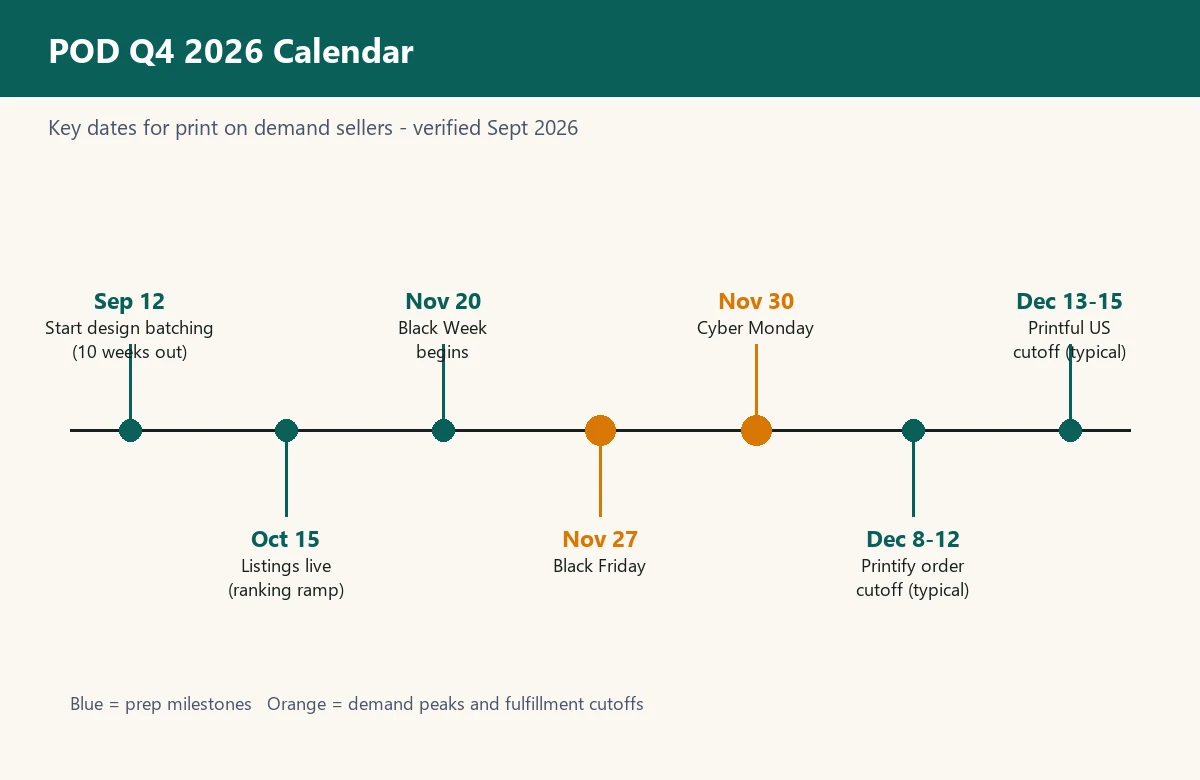
Look at the shape of that timeline rather than the individual dates. There are three preparation milestones sitting to the left of the sale, and only two demand peaks to the right of them. If your production schedule only has entries on the right-hand side, you have already lost the season - the peak is when buyers arrive, not when sellers should start thinking.
Weeks 5-6 (Oct 11-24): Get Listings Live
Publishing by mid-October is the single highest-leverage recommendation in this article, and it is the one most sellers skip because it feels premature. It is not premature. Search engines and marketplace search both need time to crawl a new listing, attach it to queries and start testing its click-through rate. Four to six weeks is a reasonable expectation for that to settle. A listing published on November 20 enters the peak with zero accumulated signal.
- Write titles for gifting intent, not just subject matter. The phrase buyers type in late November is usually 'gift for' plus a recipient or occasion, and that pairing is what your title has to contain.
- Fill in every attribute field your marketplace offers, even the ones that feel redundant. Buyers filter on them, and an empty field silently removes you from filtered results.
- Set shipping profiles per provider rather than one global rule, otherwise your delivery estimate is a fiction and your late-December messages will be about refunds.
- Write 8-10 tags mixing three axes: subject, recipient and occasion. Overlapping the same intent three ways wastes your slots.
- Add your first three listings to an internal collection or bundle page so the traffic you do get can reach the rest of the catalogue.
Weeks 7-8 (Oct 25-Nov 7): Pricing, Bundles and Ad Testing
Do not decide your Black Friday discount in November. Decide it now, in the quiet part of the calendar, when you can still do arithmetic calmly and test whether anyone clicks. Pick three price points, run a small ad budget behind two of them for a week, and let the click-through rate tell you which offer is real. Two tests concluded in late October are worth more than any amount of guessing on November 26.
That said, the discount has a real cost and it is worth seeing it before you commit. On a print on demand t-shirt priced at $24.99 with a $4.45 base cost and roughly $7.80 in combined platform fees and shipping, the net margin per order looks like this:
| Offer | Sale price | Net margin per order | Change vs full price |
|---|---|---|---|
| Full price | $24.99 | $12.74 | baseline |
| 15% off | $21.24 | $8.99 | -29% |
| 20% off | $19.99 | $7.74 | -39% |
| 25% off | $18.74 | $6.49 | -49% |
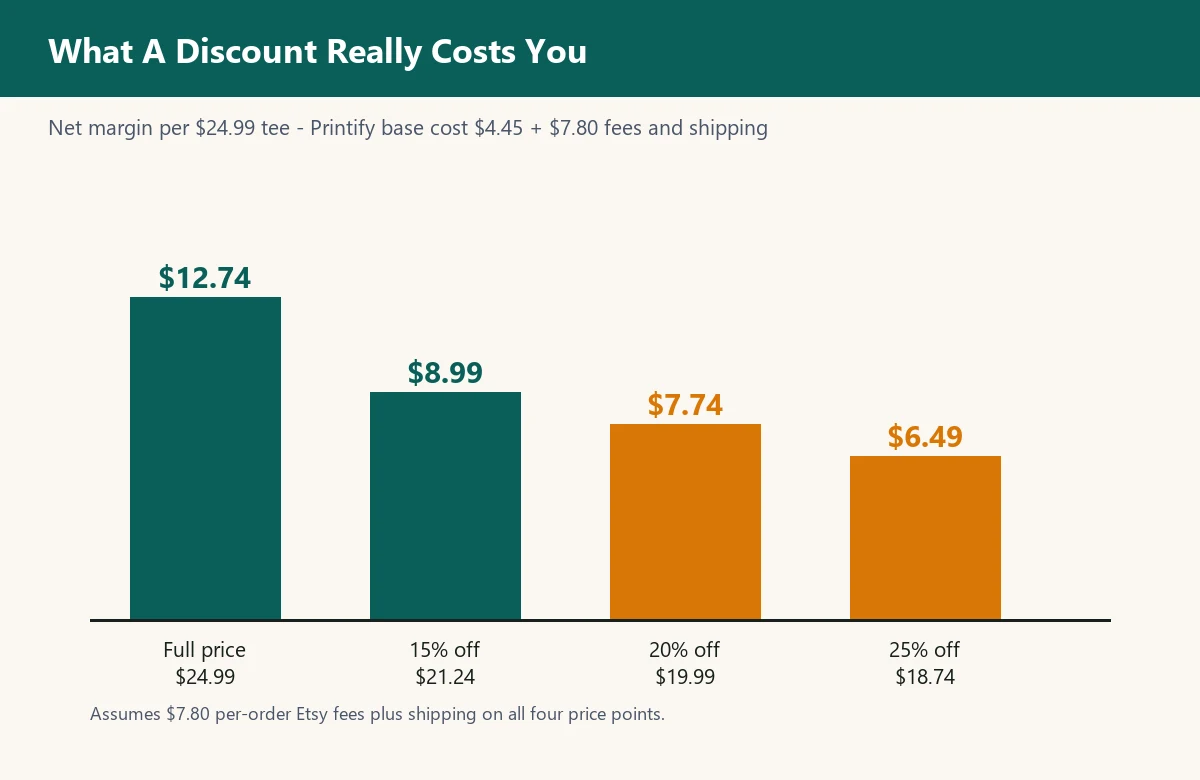
Note: Read that chart as a threshold, not a warning. A 20% discount means you need roughly 1.65x the order volume to make the same total profit. If your listings do not already get the traffic to triple, a shallower discount on a well-ranked listing beats a deep discount on an invisible one.
Weeks 9-10 (Nov 8-21): Cutoffs, QA and Final Communications
The last fortnight before Black Week is not for creating anything new. It is for closing loops. Print providers publish their holiday order deadline guides each autumn, and the practical dates for standard production and shipping in recent seasons have landed in the first half of December - Printify's typically around December 8-12 and Printful's US standard around December 13-15, with expedited options extending a few days beyond that. Treat those as planning ranges, because each provider republishes them annually and your specific product, print location and destination will move the date.
- Pull your provider's published cutoff table and translate it into one sentence your buyer can understand: 'Order by [date] for delivery before Christmas.'
- Put that sentence in the listing images, the listing description and your shop announcement - three places, same date.
- Order one sample of each product type you plan to push. A print defect discovered on December 5 is not a QA problem, it is a refund and a one-star review.
- Prepare a digital fallback for late shoppers: a gift card or an instant download with no shipping dependency. It converts the customers you would otherwise turn away after the cutoff.
- Pre-write the sale announcement, the email and the social captions. Nothing should be composed at 11pm the night before the sale starts.
Where AI Tools Actually Save Time in Q4
None of this is about generating designs for the sake of it. In a seasonal sprint the constraint is throughput - how many finished, correctly sized, well-mocked products you can publish in the three weeks that matter. Three categories of tool do almost all of the heavy lifting in my workflow.
Claid for artwork cleanup and upscaling
The bottleneck in production week is never the idea, it is the 300 DPI conversion. Seasonal artwork sourced from marketplaces arrives at wildly inconsistent resolution, with stray backgrounds and soft edges after scaling. Claid's upscaling and background handling is the step that turns a 15-minute manual cleanup per design into a batch operation, which is what makes a 40-design batch finish in two weeks instead of six. It is also the tool I would start with if you only add one thing to your stack this autumn, because it sits upstream of everything else - clean artwork also makes every downstream mockup look more expensive than it is.
Mockey for mockup sets at volume
Listing completeness is a ranking input on every major marketplace, and the cheapest way to look complete is a consistent mockup set: hero, lifestyle, detail, and one scale reference. Mockey's strength is breadth of product and scene templates, which matters in Q4 because you are mocking up the same design across a dozen product types and consistency is what makes a shop look like a brand instead of a spreadsheet. Batch the mockups in one session per design, not one session per product.
Kittl and Creative Fabrica for the asset layer
Design production still needs a layer of raw material: fonts, seasonal graphics, sublimation patterns and text treatments. Kittl is the faster surface for composing those into sale-ready compositions, and Creative Fabrica is where the seasonal asset volume lives - its free picks rotate daily and are worth monitoring from September onward precisely because holiday-themed bundles appear in them weeks before commercial demand peaks. Build that asset library in September and you will spend October producing instead of shopping.
✓ Pros
- The ten-week calendar costs nothing to follow and removes the single most common Q4 failure - publishing too late to be indexed.
- Print on demand means no inventory risk during the peak: you scale traffic, not stock, and unsold designs cost you only the listing fee.
- Margin arithmetic is knowable in advance, so the discount decision becomes a threshold calculation rather than a guess.
- The same design batch that serves Black Friday also serves Cyber Monday, the December gifting window and the post-Christmas lull, so production week is amortised across three events.
✗ Cons
- This playbook cannot fix a weak design batch. If the concepts are not giftable, ten weeks of preparation converts nothing.
- Cutoff dates move every year and vary by product and destination, so the ranges here are planning aids and must be replaced with your provider's published table before you promise anything to a buyer.
- Marketplace search behaviour differs between Etsy, Amazon Merch and your own Shopify store - the publishing timeline is portable, the title formula is not.
- It assumes you can produce and mock up in batches. If every design needs heavy manual retouching, the schedule needs to start earlier than September.
Shipping Cutoffs Are a Refund Machine, Not a Detail
Here is the pattern behind almost every angry December message in print on demand: the seller discounted hard, the listing ranked, the order arrived, and the customer bought on December 12 expecting a hand-made item at their door by the 18th. The product was fine. The promise was not. Unlike a warehouse seller, you cannot expedite your way out of this, because you do not control production - your provider does, and in December their queue is full.
So treat the cutoff as a marketing asset rather than fine print. Publish the date early, repeat it in three places, and offer the digital alternative after it. In practice I see three outcomes from doing this properly: fewer refund requests, better review sentiment in January, and - counter-intuitively - more full-price sales before Black Friday, because a shop that clearly states its delivery promise reads as a shop that will actually deliver.
Mistakes I Made in My First Q4
- I started in November and blamed the algorithm. The listings simply were not indexed yet; there was no signal to rank.
- I discounted before testing. The offer I thought was strong had a worse click-through rate than a smaller discount with a bundle attached.
- I used one global shipping profile for three providers, so delivery estimates were optimistic for the slowest one - which is the only one that matters when a parcel is late.
- I skipped samples to save money in October, then paid for it in refunds in December.
- I uploaded artwork at screen resolution and fixed DPI after publication, which invalidated the mockups and meant re-rendering every image during the peak.
- I treated the cutoff date as a legal footnote instead of the most useful piece of information on the page.
The Bottom Line
Black Friday in print on demand is not a selling event you turn up to. It is the visible end of a process that starts in September, when nobody is watching and nothing feels urgent. Design by October 10, publish by October 17, lock your discount by November 14 and publish your cutoff dates by November 20. Do those four things and the peak becomes a test of whether your typography works, rather than a scramble to be seen at all.
Frequently Asked Questions
When should print on demand sellers start preparing for Black Friday 2026?
Ten weeks out - around mid-September for Black Friday on November 27, 2026. The binding constraint is not production, it is indexing: marketplace and search engines need roughly four to six weeks to crawl a new listing and begin ranking it. Listings published in November enter the peak with no search history, which no discount can substitute for.
Does print on demand sell well on Black Friday?
Yes, and the demand is documentable. Adobe Analytics measured $14.25 billion in US online spending on Cyber Monday 2025 alone, up 7.1% year over year, with the five-day Thanksgiving window reaching $44.2 billion and the full 2025 holiday season a record $257.8 billion. The margin question is separate from the demand question: a POD seller has no clearance inventory to dump, so the discount is a choice rather than a necessity.
What shipping cutoff should I advertise for holiday orders?
Use your print provider's published holiday order deadline guide, which is republished each autumn. In recent seasons the practical standard-shipping cutoffs have fallen in the first half of December - typically around December 8-12 for Printify and December 13-15 for Printful US standard - but the exact date moves by product, print location and destination each year. Advertise the date for your slowest product, not your fastest.
Do I need to hold inventory for Black Friday with print on demand?
No, that is the core advantage. With Printful, Printify, Gelato or a comparable network, production only happens after an order is placed, so there is no stock to buy in advance and no unsold inventory at the end of the season. The trade-off is speed: you cannot expedite production in December beyond what your provider offers, which is why cutoff communication carries more weight in POD than in retail.
Should I run a separate offer on Cyber Monday?
Yes, treat it as a second peak with a different offer rather than an extension of Black Friday. Adobe's 2025 data shows Cyber Monday standing on its own as a record spending day, so the audience is not identical to the Friday crowd. A distinct bundle or free-shipping threshold on Monday typically performs better than simply repeating Friday's discount, and it protects your margin on Friday's higher-intent buyers.
How many designs should a POD seller prepare for Q4?
Plan in breadth, not perfection: three micro-niches and forty or more concepts drafted as cheap thumbnails, then narrow to the twenty or thirty worth finishing at print resolution. Seasonal demand is uneven across niches, and a wider batch is how you discover in October which direction actually has gifting traffic instead of guessing in September and discovering the answer in December.
Keep Reading
Print Price AI Tools 2026: How to Price Print on Demand Products
Halloween POD Ideas 2026: Designs, Niches and Margin Math
Affiliate Disclosure: Some links on this page are affiliate links. We may earn a commission if you make a purchase through these links, at no additional cost to you. All reviews are based on honest, independent testing by print industry professionals. See our full disclosure.